

Having Trouble Locating Irish Genealogy Records?
- Cannot travel to Ireland,
- Don’t know where or how to find them,
- Worried about the cost?
We can help..
Free Consultation



Irish Researchers - Hire an Irish Genealogist

Cora M
★ 4.7/5 (67 jobs)
Genealogy Researcher
Tour Guide
Dublin, Ireland

Hailey D
★ 4.9/5 (53 jobs)
Genealogy Researcher
Galway, Ireland

Sienna M
★ 4.8/5 (100+ jobs)
Genealogy Researcher
Librarian
Belfast, Northern Ireland

Ivan L
★ 4.9/5 (100+ jobs)
Genealogy Researcher
Tour Guide
Cork, Ireland

Shane H
★ 4.8/5 (84 jobs)
Genealogy Researcher
Waterford, Ireland

Sara M
★ 4.6/5 (39 jobs)
Genealogy Researcher
Archivist
Dublin, Ireland

Victoria G
★ 4.9/5 (100+ jobs)
Genealogy Researcher
Ireland
4 more
Are you eager to uncover your Irish roots but find yourself at a loss on where to begin? Delving into Irish family history research can be both a fulfilling journey and a daunting task, especially when distance and access to records pose challenges. At Irish Researchers, we specialize in guiding individuals through this intricate process, offering tailored genealogy services that bring your ancestral story to life.
Customer Testimonials
Independent Testimonials at Trustpilot.com:
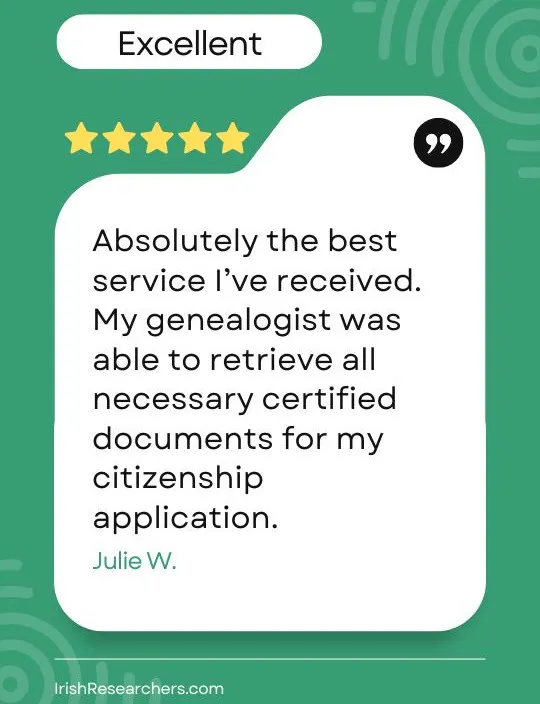
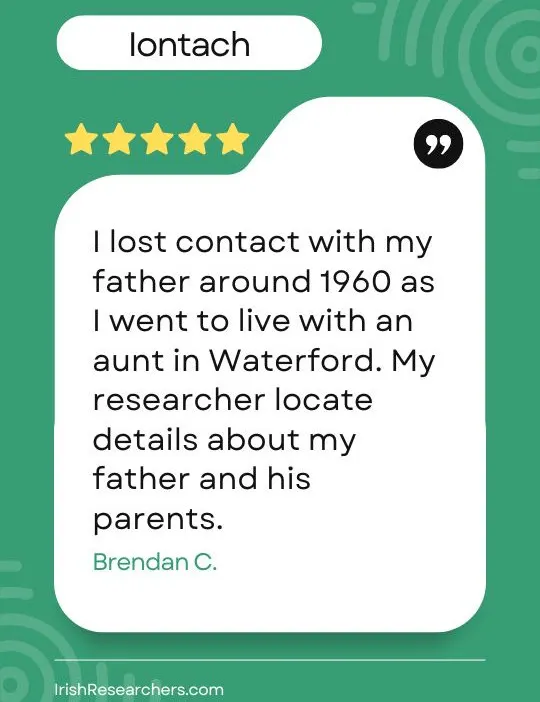
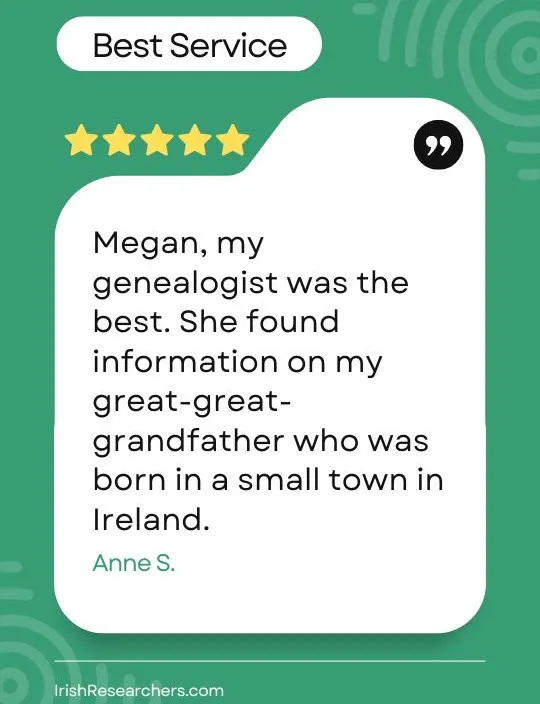
View all our reviews @ Trust Pilot
How does Irish Researchers work?
Search Details
Share with us your search parameters in Ireland. If you have a family tree, we may request access.
Free Preliminary Search
Based on the details you’ve provided, we will conduct a free preliminary search to assure we can deliver results.
Work with Genealogist
If you decide to hire us, we will assign a genealogist to your project and provide you with direct contact details.
Share Results
You’re part of the journey, so you can ask questions during the search. After the project is done a full report will be provided.
Records
Comprehensive records search
- Identify the Specific Location
- Utilize Online Databases
- Leverage Local Resources and Archives
Citizenship
Dual citizenship application assistance
- Gather Relevant Documents
- Research Irish Citizenship Requirements
- Access Irish Genealogical Resources
Heritage
Irish Heritage & Ancestry Search
- Build & Extend Family Trees
- Break through Genealogy “Brick-Walls”
- Coat of Arms research & identification
Family
Lost Family & Ancestral Search
- Discover significant sites or points of interest
- Find unknown family members
- Tours
We will do our very best to help you
If you are eager to trace your Irish ancestry and get it done with precision, and tailored to your preference, then you are welcome. It can be quite challenging to try and trace back to an Irish ancestor but with the right professional help and resources it is achievable. Allow us to guide you on your journey as we explore the Irish family trees of your family history.
What does Irish Researchers do?
Irish Researchers is a team of professional genealogists, founded in 2015, who trace Irish ancestry through civil, parish, census and archival records in Ireland and Northern Ireland. Projects start with a free preliminary search, packages start at $795, and most projects are completed in 1 to 3 weeks.
Where can I find an Irish genealogist?
At Irish Researchers, we offer specialized genealogy services, guiding you along the way and helping you interpret the historical contexts associated with your heritage. Our dedicated team of genealogists is local to Ireland and brings a wealth of skill and experience to your family history journey. They leave no stone unturned to present a detailed report tailored to meet your needs and help you identify with your heritage.
Why choose Irish Researchers?
1. Customized Research Service
Every family is unique, as is their history. Therefore, we tailor our research based on your interests and expectations. Our experts start with what you provide as evidence and basis and dig deeper into archives and the National Library of Ireland to ensure they maximize the allocated research time to deliver the most results without compromising quality.
2. Packages from $795
At Irish Researchers, we offer the highest quality at a reasonable fee. Our affordable packages provide options based on your desired research scope and budget. We are also open to discussing your unique request and may consider a special fee for your case (See Our Pricing).
3. Exclusive Resources
Records are the backbone of genealogy research, and we endeavor to leverage reliable resources to ensure accuracy and thoroughness in your final report. Our team of professional genealogists has access to exclusive databases and many records that amateurs may not find online. As members of Accredited Genealogists Ireland (AGI), we have networks and accesses unavailable through DIY.
What genealogy services does Irish Researchers offer?
1. General Family History Research
General family history research is our most popular service. It entails tracing your lineage back through generations and compiling a comprehensive report. In addition to names and dates, the report includes a detailed visual family tree, additional historical context presented coherently, and the necessary documents to back up any discovery.
2. Advanced Genetic Research
We combine traditional genealogy research methods with cutting-edge DNA testing to verify discoveries on historical records, expand your research scope, and provide a full picture of your genetic heritage. DNA also comes in handy when focusing on a single line of your ancestry.
3. A Genealogical Narrative
Family history research is more about the evolution in your family than just numbers and names. For this reason, we provide a clear narrative about your family’s evolution and interpretation of certain events that describe your ancestors’ lives and places. Our experts will help you understand everything in your report to make it a continuous narrative down generation.
What do clients say about Irish Researchers?
We have assisted our clients in tracing their family matters, tracing their lost Irish relations, and constructing family trees and relationships. Using our services, we help multiple families reconnect with their Irish roots, which we have witnessed in positive reviews and appreciation on our website.
How do I get started?
Take advantage of our free consultation and embark on your Irish genealogy journey with Irish Researchers. We have a dedicated team of professional genealogists who are eager to get started and discover the defining history of your family.
You can reach us today for more information about our services and on how to commence your personalized genealogy investigation.
FAQs
How can I benefit from hiring a professional Irish genealogist?
A professional Irish genealogist knows where Irish records survive, works in Irish archives and parish registers that are not online, and can connect records that are hard to link on your own. You get sourced records and a written report, not guesses.
What information do I need to provide to start the research process?
Share as much as you know about your Irish ancestors: names, dates, places (county, parish or townland if known) and any family trees or documents. We use this for a free preliminary search to confirm what is possible before you pay.
How long does it typically take to receive results from a genealogical research project?
Most projects are completed in 1 to 3 weeks. Complex cases can take longer, and we give you a realistic timeline at the free consultation.
What types of records and documents can your genealogists access?
We access civil birth, marriage and death records, Catholic and Church of Ireland parish registers, the 1901 and 1911 censuses, Griffith’s Valuation, land and emigration records, and archives across Ireland and Northern Ireland.
How much does hiring a professional genealogist cost?
Irish Researchers packages cost $795 for 5 hours, $1,272 for 10 hours and $2,226 for 20 hours of research. Every package includes sourced records and a written report.